

LPC Supervision with Hayley in Texas
You're Working Toward a License.
I'm More Interested in How You Practice Once You Have It.

Dr. Hayley Willis, PsyD, LPC-S
A license tells me you've met the requirements to practice independently. What interests me is whether you've developed the knowledge, judgment, and confidence to make sound clinical decisions when someone is depending on you.
That's what I believe supervision should prepare you for.
My approach is practical, direct, and focused on helping you become a capable clinician who understands not only what they're doing, but why. I want you to develop your own professional identity, recognize your strengths and limitations, and learn how to navigate the responsibilities that come with independent practice.
You don't need to have everything figured out when we begin. Developing those abilities is part of the reason we're working together.
I don't expect you to practice as I do. I expect you to understand your decisions, explain your reasoning, and recognize when something needs to change.
I don't expect you to practice as I do. I expect you to understand your decisions, explain your reasoning, and recognize when something needs to change.
Why Work With Me as Your LPC Supervisor?
My experience spans private practice, community-based mental healthcare, and the Department of Veterans Affairs. I've worked with diverse populations and complicated clinical presentations, often in settings where treatment decisions must account for competing priorities, organizational policies, and limited resources.
My clinical work focuses primarily on trauma, PTSD, anxiety, and depression, using approaches such as CBT, CPT, SFBT, and EMDR. Over the years, I've learned the importance of looking beyond presenting symptoms to understand what's maintaining a client's difficulties, evaluating whether treatment is actually helping, and knowing when a different approach is warranted.
I've also developed clinical programs, collaborated with multidisciplinary healthcare teams, and supervised graduate counseling interns. My doctorate in psychology included research on ethical decision-making in correctional mental healthcare, particularly the challenges clinicians encounter when their professional obligations conflict with institutional expectations.
So, why does any of this matter for your supervision?
Because much of what I've learned came from situations that weren't easily resolved by following a textbook or treatment manual.
I bring those experiences into supervision through case examples, practical guidance, and discussions about the considerations that influence clinical decisions. I'll share what has worked, what hasn't, and what I would approach differently today.
You'll have access to my experience and perspective while developing the professional knowledge and skills necessary for your own clinical work.
What You Can Expect From LPC Supervision With Me
I approach supervision with a clear purpose, but I don't believe every meeting needs to follow the same agenda. What we focus on will depend on your cases, your experience, and the areas where you need additional development.
Some sessions will involve reviewing a complicated case or evaluating a treatment plan. Others may focus on documentation, professional boundaries, ethical concerns, or developing a specific clinical skill. When something isn't working, we'll examine why and determine what needs to happen differently.
I want our time to reflect what you actually need to work on, not simply fill an hour on the calendar.
A few things you can count on from me:
Direct, constructive feedback. I'll tell you what you're doing well, where I see concerns, and what needs improvement. I'll also explain my reasoning and help you identify practical ways to strengthen your work.
Hands-on clinical guidance. We may break down a case conceptualization, reconsider a diagnosis, review documentation, discuss alternative interventions, or work through how to handle a difficult conversation with a client. I won't simply tell you something needs to improve without helping you understand how.
Room for professional discussion. You can question my recommendations, explore different clinical approaches, and bring perspectives I may not have considered. Supervision should involve thoughtful discussion, not unquestioned agreement.
Supervision that changes as you develop. Someone beginning their associate experience generally needs more structure and guidance than someone approaching independent licensure. I'll adjust my involvement as you demonstrate greater competence and readiness to manage clinical responsibilities.
Support for your professional interests. Whether you're interested in trauma treatment, specialized training, a different clinical setting, or eventually opening a private practice, we can discuss how those goals fit into your professional development.
If we're spending an hour in supervision, I want that hour to matter.
You should leave with something you can apply, a clearer understanding of a clinical concern,
or a specific area to work on before we meet again.
What I Need From You
Supervision works best when you're actively involved in your own development. I'm not expecting perfection, but I do expect you to take your responsibilities seriously.
Come prepared to discuss your clinical work, including the cases you're uncertain about, decisions you're questioning, and situations you haven't handled as well as you would have liked. If you're struggling, tell me. If you make a mistake, be willing to examine what happened. Those conversations are often where some of the most useful learning takes place.
I also expect you to follow through. If we identify a skill that needs improvement, a concern that requires attention, or something you need to approach differently, I want to see you make an effort to apply what we've discussed. We can spend an hour talking about clinical development, but the real work happens when you return to your clients and put that learning into practice.
Finally, be willing to participate in honest conversations, including the uncomfortable ones. You don't need to agree with every recommendation, but you do need to be able to discuss your decisions professionally, consider feedback, and remain accountable for the care you're providing.
Getting licensed is the requirement.
Becoming someone who can practice competently without a supervisor is the point.
Interested In LPC Supervision With Me?
Choosing a supervisor shouldn't be a guessing game. Before either of us makes a commitment, I want to understand what you're looking for and give you a clear idea of what working with me would involve.
Complete the interest form, and I'll contact you to schedule a consultation. We'll discuss your experience, professional goals, expectations, and any questions you have.
An honest conversation to determine whether we're a good fit.
FAQs about LPC Supervision with Hayley in Texas
-
LPC supervision is a required period of clinical experience that counselors must complete before becoming independently licensed in Texas. During this time, LPC Associates provide counseling services under the oversight of an approved LPC Supervisor (LPC-S), who offers clinical guidance, evaluates their work, and helps ensure they're practicing competently and ethically.
Texas LPC Supervision Requirements
To qualify for independent licensure, LPC Associates must complete:
3,000 hours of supervised clinical experience, including at least 1,500 hours of direct counseling services with clients.
A minimum of 18 months of supervised experience, regardless of how quickly the required hours are accumulated.
At least four hours of supervision per month with an approved LPC Supervisor.
Documentation of completed clinical and supervision hours, with verification provided by the supervisor.
These are the minimum requirements established by the state. Associates must also maintain an active LPC Associate license and comply with applicable professional and ethical standards throughout their supervised experience.
For current licensing requirements and additional guidance, visit the Texas Behavioral Health Executive Council (BHEC).
-
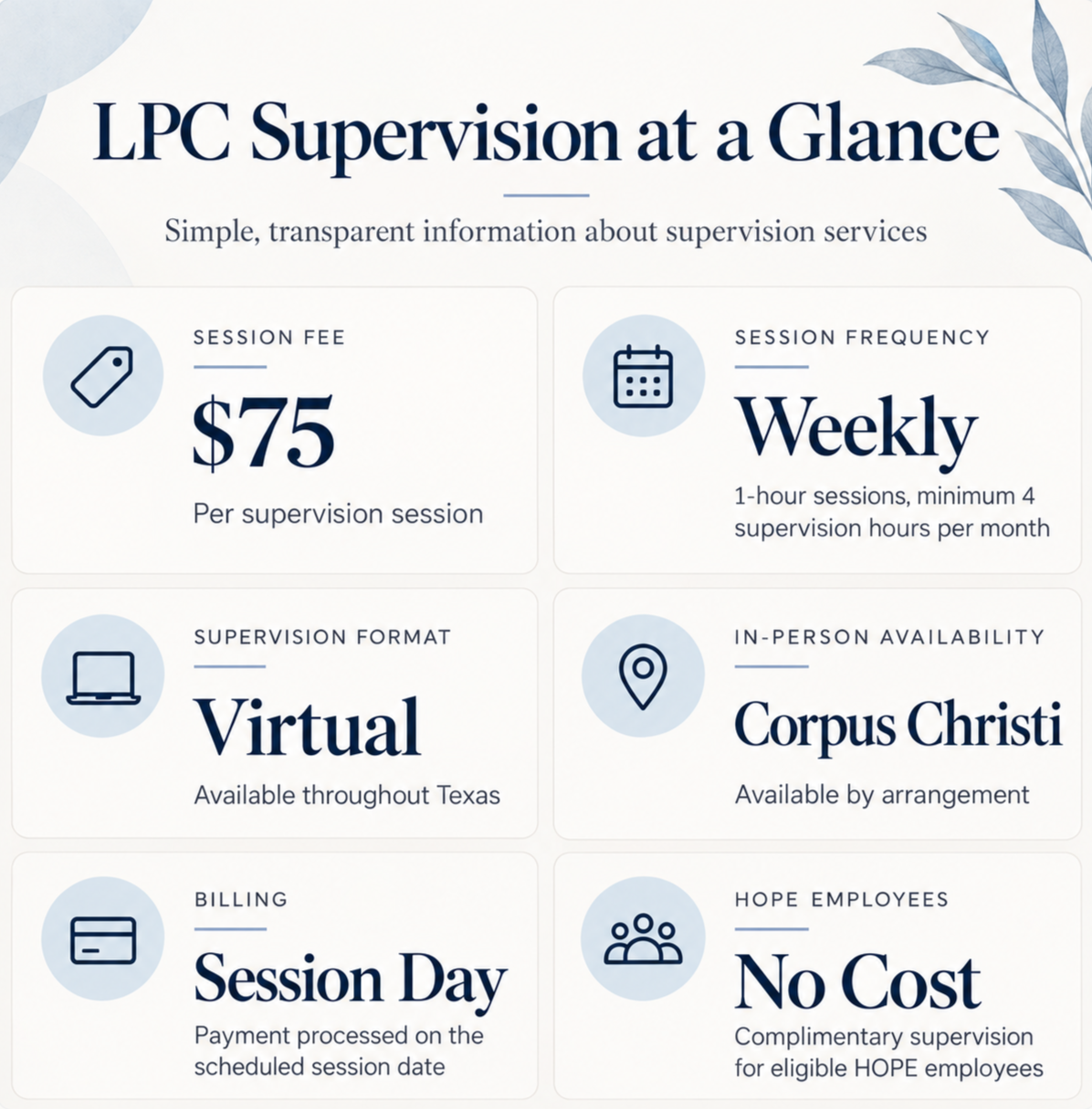
My LPC supervision rate is $75 per one-hour session, with payment processed on the day of your scheduled appointment.
Supervision consists of four one-hour sessions per month, totaling $300 monthly. Months with five calendar weeks do not require an additional session.
* LPC supervision is provided at no cost to eligible HOPE Therapeutic Alliance employees.
We'll review scheduling, payment arrangements, and supervision expectations during our initial consultation so you know exactly what to expect before making a commitment.
-
Start by making sure your potential supervisor is an approved LPC-S in good standing with the State of Texas. You can verify their credentials through the Texas Behavioral Health Executive Council (BHEC). Beyond that, I encourage you to ask questions that actually tell you something about the person you'll be working with.
Find out about their clinical experience, how they approach supervision, and what they expect from their associates. Do they provide meaningful feedback? Are they willing to address mistakes and difficult situations? Will they help you develop your own clinical judgment, or do they expect you to practice exactly as they do?
Consider your professional interests as well. If you want to specialize in a particular treatment approach or work with a specific population, look for someone whose experience can contribute to that development.
Don't overlook the practical details either. Discuss fees, scheduling, supervision format, availability for urgent consultation, and the expectations outlined in your supervision agreement.
My advice? Talk with more than one supervisor before making a decision. You should feel comfortable asking questions and being honest about what you don't know, but you should also expect to be challenged.
The right supervisor isn't necessarily the person who makes the process easiest. It's someone whose experience you respect, whose feedback you can learn from, and who will take your professional development seriously.
And yes, I'd encourage you to compare your options even if I'm one of the supervisors you're considering.
-
Once you've decided who you'd like to work with, the next step is making the arrangement official. This includes completing the necessary documentation with the Texas Behavioral Health Executive Council (BHEC), establishing a supervision schedule, and reviewing the expectations of the supervisory relationship.
If you choose to work with me, we'll begin by reviewing your LPC Associate license status, clinical work setting, professional goals, and any previous supervised experience.
We'll also review and sign a Supervisor–Supervisee Contract, which outlines our respective responsibilities, supervision expectations, confidentiality, documentation requirements, fees, cancellation policies, procedures for addressing clinical concerns, and circumstances that may require changes to or termination of the supervisory relationship.
I'll walk you through my onboarding process, explain how we'll track and document your clinical hours, and establish your schedule for four one-hour supervision sessions each month. We'll also discuss how to prepare for meetings and when and how to contact me if something comes up between sessions.
Before supervision begins, we'll make sure the required agreements and applicable board procedures have been addressed.
I don't expect you to know everything about navigating the supervision process. I'll explain what needs to happen and what you're responsible for along the way.
Once we've handled the administrative side, we can focus on the reason you're here: becoming a competent, independent counselor.
-
Yes. Texas allows LPC Associates to work with up to two approved LPC Supervisors at the same time. You can also change supervisors if your professional needs, employment situation, or supervision preferences change.
Adding or changing supervisors requires properly documenting the supervisory relationship with the Texas Behavioral Health Executive Council (BHEC). Your supervisor can help you navigate the required agreements and reporting procedures.
If you're interested in transferring your supervision to me or adding me as a second supervisor, we can discuss your current arrangement, completed clinical hours, and what would be involved in making that change.
For current requirements, visit the BHEC Supervision FAQs.
-
I primarily offer virtual LPC supervision throughout Texas, allowing you to attend your weekly supervision sessions without the additional travel time.
For LPC Associates in the greater Corpus Christi area, in-person supervision may also be arranged based on availability.
We'll discuss your preferred format and scheduling needs during our initial consultation.
-
Our one-hour sessions are guided by what's happening in your clinical work and the issues you've identified for discussion.
Typically, we'll start with any pressing clinical concerns, review the cases or questions you've brought, and spend time addressing the areas that need attention. Depending on the situation, that might involve examining a clinical decision, working through a specific problem, or identifying something to practice before our next meeting.
Not every session will look the same. Some will require more structured guidance, while others may involve discussing your reasoning and exploring different options. We'll also revisit previous recommendations when needed to assess what's changed and whether additional support is necessary.
You won't need to prepare a formal presentation every week, but you should come with a reasonable understanding of what you'd like to address.