The Vehlin: Learning to Hold Stillness Before Change
The Space Nobody Talks About
Most people think change begins with action
We imagine transformation as the moment someone leaves the relationship, starts therapy, sets the boundary, changes careers, forgives the betrayal, or finally decides to move forward. We tend to focus on the visible moment because it is easy to identify. There is a before and an after. A decision is made. A new chapter begins.
What often gets overlooked is the space that exists before any of that happens.
There is a period that comes before every meaningful change, and it is rarely comfortable. It is the season where you know something is different, but you are not yet sure what to do with that realization. It is the moment when your mind is pulling in multiple directions, your emotions are competing for attention, and every part of you wants certainty that simply is not available yet.
Most of us spend our lives trying to escape that space.
We distract ourselves from it, rush through it, seek reassurance from others, or convince ourselves that immediate action is always better than waiting. We often mistake movement for progress because standing still can feel unsettling. Yet some of the most important moments of personal growth happen before a decision is ever made.
They happen in the pause. That pause is what inspired The Vehlin.
Where The Vehlin Came From
The experience The Vehlin represents is not new.
Human beings have been wrestling with uncertainty, reflection, self-control, and awareness for as long as we have existed. Philosophers have written about it. Spiritual traditions have practiced it. Therapists help people build it every day. The space between impulse and action is not a new discovery. What felt missing to me was not the concept itself, but a way to see it.
Throughout my work as a therapist, I repeatedly found myself helping people navigate a particular kind of moment. It was not the crisis itself, and it was not the resolution that came afterward. It was the period in between. The uncomfortable space where someone recognized that something needed to change but had not yet decided how. The moment after awareness arrived but before clarity followed.
I noticed that people often struggle to trust that space. When certainty is absent, many of us assume something is wrong. We rush toward decisions, seek reassurance, distract ourselves, or try to force an answer before it is ready. We treat uncertainty as a problem to solve rather than an experience to move through.
Yet some of the most meaningful growth I have witnessed has happened in exactly those moments. It happens when someone sits with a difficult truth long enough to understand it. It happens when a person learns they do not have to react immediately to every emotion they feel. It happens when competing thoughts, fears, hopes, and possibilities are allowed to exist together before one path is chosen.
Over time, I found myself wanting a way to represent that experience visually. Not because the idea was new, but because it was important. I wanted something that could serve as a reminder that the pause itself has value. Something that could communicate, without words, that uncertainty is not always a sign of confusion and that stillness is not the same as being stuck.
The Vehlin became that symbol.
It was created to represent the moment before movement, the space where awareness exists before action, and the place where a person can remain present with themselves without rushing toward an answer. In many ways, The Vehlin is not a symbol about finding certainty. It is a symbol about learning to trust yourself while certainty is still forming.
What The Symbol Represents
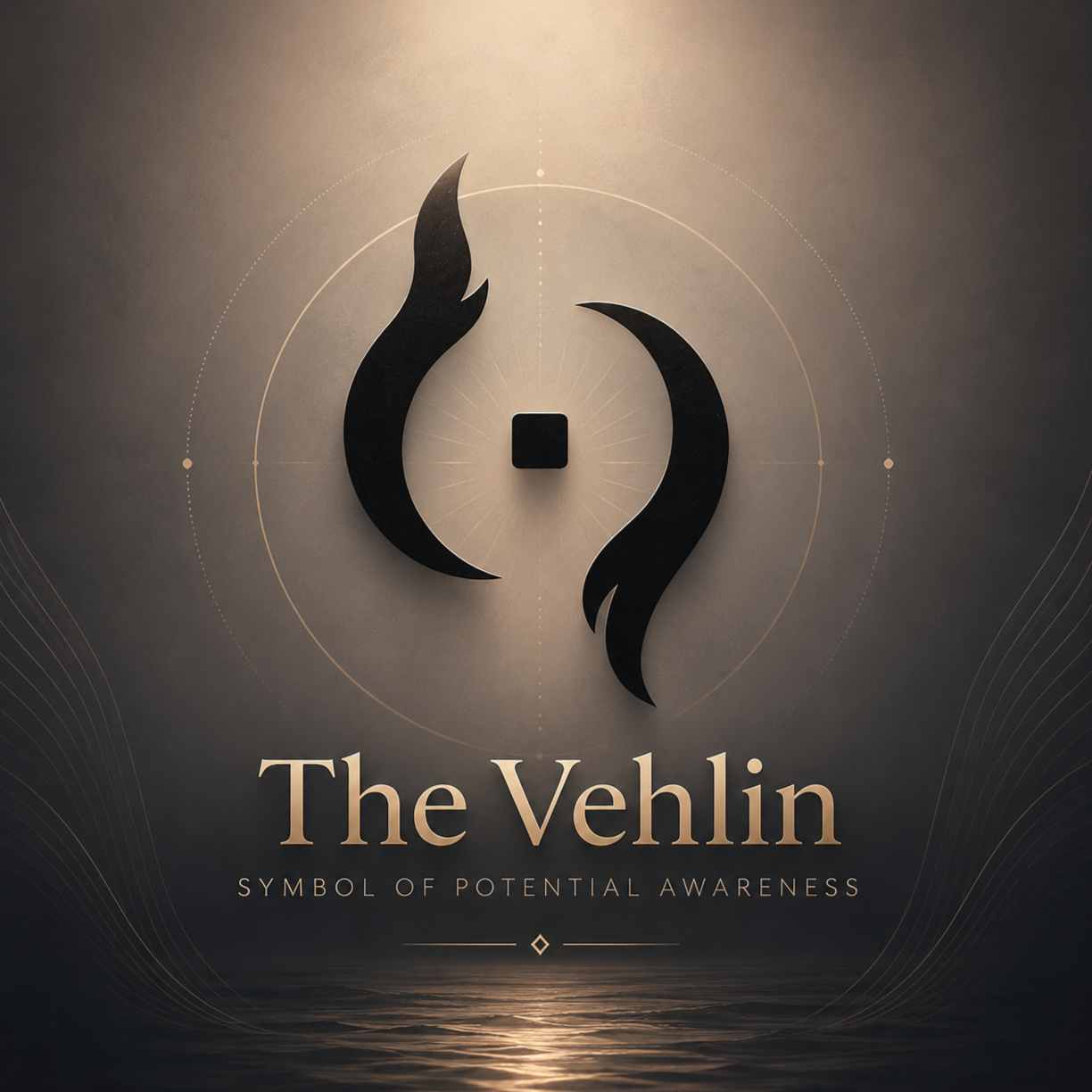
The Vehlin consists of two arcs facing one another without touching. Between them exists an open space, and at the center rests a square. While the design itself is simple, the meaning behind it is intentionally layered.

The two arcs represent opposing forces that exist within all of us. Sometimes those forces are fear and courage. Sometimes they are grief and hope, certainty and doubt, anger and compassion, or control and surrender. Human beings often experience these opposites as though one must defeat the other, but real growth rarely works that way.
Many of life's most difficult moments involve holding two truths simultaneously.
You can love someone and recognize that the relationship is unhealthy. You can be grateful for an opportunity and still feel overwhelmed by it. You can be making progress while also feeling exhausted. You can be healing while still hurting.
The arcs of The Vehlin symbolize those tensions.
The space between them represents awareness. It is the place where you are not consumed by either side. It is where you pause long enough to observe what is happening within you before deciding what comes next.
At the center is the self. Not the anxious part of you. Not the angry part of you. Not the wounded part of you. Simply you.
The person who gets to choose how to respond.
Why Stillness Feels So Difficult
One of the reasons The Vehlin resonates with many people is because stillness is surprisingly uncomfortable.
We often tell ourselves that we want peace, but when peace requires uncertainty, we frequently resist it. The mind naturally seeks resolution. When we feel anxious, we want reassurance. When we feel hurt, we want answers. When we feel conflicted, we want certainty.
The problem is that certainty is not always available when we want it. Sometimes there is no immediate answer to the question you are asking. Sometimes there is no clear sign pointing in the right direction. Sometimes the next step does not reveal itself until you have spent time sitting with the reality of where you currently are.
This can be frustrating because modern culture tends to reward speed. We celebrate quick decisions, immediate solutions, and rapid progress. We are encouraged to optimize, improve, fix, and move forward as efficiently as possible.
Healing rarely follows that timeline. Growth often requires patience. It requires reflection. It requires the willingness to tolerate temporary uncertainty while something deeper develops beneath the surface. The Vehlin serves as a reminder that the pause itself has value.
Waiting is not always avoidance. Sometimes waiting is wisdom.
What The Vehlin Means in Therapy
In therapy, much of the work involves helping people expand their ability to remain present in difficult emotional spaces. Many clients arrive believing they need answers. They want to know whether they should stay or leave, forgive or protect themselves, push forward or step back. While answers are important, therapy often begins somewhere else.

It begins by creating enough space to understand the question more clearly. When emotions become intense, people naturally move toward action. Some react impulsively. Others withdraw completely. Some become consumed by overthinking. Others seek constant reassurance. These responses make sense because they provide temporary relief.
The challenge is that relief and resolution are not the same thing. The Vehlin represents the ability to remain present between emotion and reaction. It symbolizes the moment where you notice what is happening within yourself without immediately acting upon it.
For trauma survivors, this concept can be particularly important. Many traumatic experiences teach people that immediate reaction is necessary for survival. Hypervigilance, emotional reactivity, avoidance, and protective behaviors often develop for understandable reasons. Learning to pause can feel unfamiliar or even unsafe.
Part of the healing process involves discovering that not every emotion requires immediate action. Not every thought requires belief. Not every feeling requires a response. The space represented by The Vehlin becomes a place where observation can occur without judgment.
Bringing The Vehlin Into Daily Life
Although The Vehlin emerged from therapeutic work, its meaning extends far beyond the counseling office. It can serve as a reminder during moments of stress, conflict, uncertainty, or transition. Whenever you find yourself feeling pulled in multiple directions, the symbol offers an opportunity to pause and ask a different question.
Instead of asking, "What should I do right now?" you might ask, "What am I noticing right now?"
That shift may seem subtle, but it creates room for awareness. You might notice fear beneath your frustration. You might recognize grief hidden underneath anger. You might realize that what feels like confusion is actually the presence of two competing values that both matter deeply to you.
The goal is not to remain in The Vehlin forever. Eventually, decisions must be made and actions taken. The purpose is simply to spend enough time there to ensure that your actions reflect intention rather than reaction. In time, many people discover that the quality of their decisions improves when they stop demanding immediate certainty from themselves.
The Meaning Behind the Pause
Perhaps the most important thing The Vehlin represents is permission.
~ Permission to not have everything figured out.
~ Permission to sit with a difficult question a little longer.
~ Permission to acknowledge conflicting emotions without forcing them into a simple answer.
~ Permission to recognize that uncertainty is not always a sign that something is wrong.
The older I become, the more convinced I am that many of life's most meaningful transformations happen quietly. They occur long before anyone else notices. They emerge during moments of reflection, contemplation, and honest self-examination. They develop while we are learning how to stay present with ourselves rather than rushing toward an outcome.
The Vehlin was created to honor that process.
It is not a symbol of perfection, balance, or certainty. It is a symbol of awareness. It reflects the understanding that growth often begins before clarity arrives and that the moments between knowing and acting may be far more important than we realize.
Every person will encounter that space repeatedly throughout life. It appears during grief, healing, relationships, career changes, identity shifts, and countless other transitions. Whenever it arrives, there is often a temptation to rush through it.
The Vehlin offers a different invitation. It invites you to remain there for a moment longer.
To breathe → To observe → To listen → To remember that the pause is not empty.
Sometimes the pause is where everything begins.