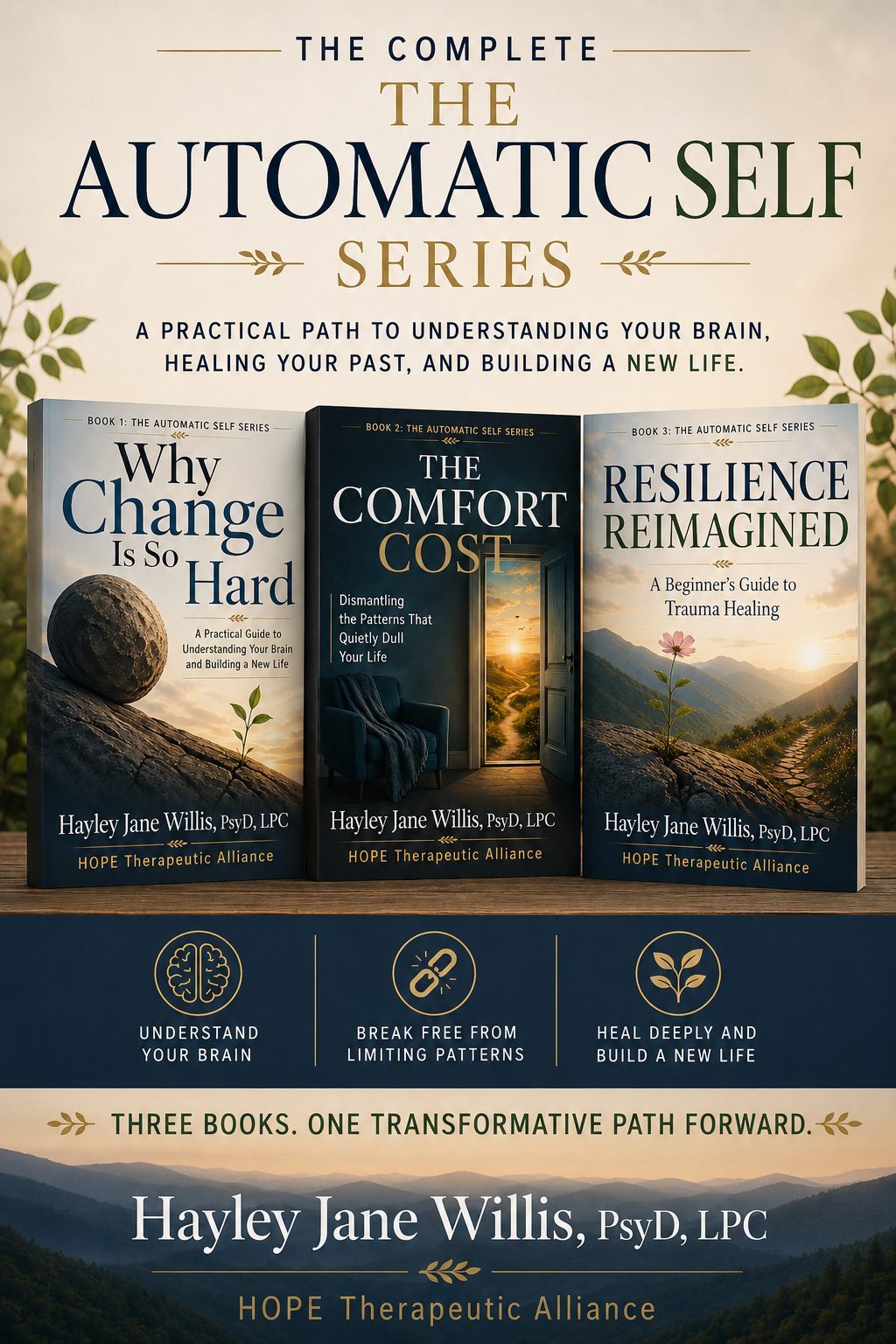
The Automatic Self: Why You’re Stuck, What’s Running You, How to Change It.
Most people assume the way they think, feel, and behave reflects who they are. In reality, many of these patterns were learned, reinforced through experience, and repeated until they became automatic.
The Automatic Self Series explores how these patterns develop, why they persist, and what it takes to change them. Drawing from psychology, trauma theory, and behavioral science, the series examines the hidden processes that shape identity, relationships, resilience, and personal growth.

Most believe they understand themselves because their behavior feels consistent. You can likely predict how you will respond in difficult conversations, how you handle pressure, and how you manage expectations in relationships and work. That consistency creates a sense of clarity. You describe yourself with confidence using words that feel accurate and stable. You might call yourself driven, independent, direct, or accommodating, and those descriptions feel earned because they have been reinforced over time.
The problem is not that those descriptions are wrong. The problem is that they are incomplete in a way that prevents further examination.
Consistency creates the illusion of identity.
When something shows up repeatedly, it begins to feel like truth rather than pattern. Over time, the distinction between what you do and who you are becomes less clear. You stop observing your behavior and start explaining it. What began as a response becomes a definition.
What you are calling personality is often a refined set of adaptive strategies that became efficient enough to feel automatic. These responses developed in environments where they increased your ability to function, maintain connection, or reduce risk. Control reduced uncertainty. Withdrawal limited exposure. Performance maintained acceptance. Each of these responses solved a problem at some point, and because they worked, they stayed.
It is not your personality. It is your most practiced response.
I. When Tools Become Walls
Once a behavior becomes automatic, it stops being questioned. Once it stops being questioned, it becomes something you defend. You no longer ask where it came from or whether it is still necessary. You use it to explain yourself instead of examining it in real time. This is how patterns become embedded. They shift from tools into structure.
That shift has a cost that is easy to miss because nothing appears to be failing. Your life functions. Your responsibilities are managed. Your relationships are intact. From the outside, there is no obvious reason to disrupt what works. Internally, something more subtle begins to change. Your responses become faster and more predictable, but also more limited. You handle situations efficiently, but not always intentionally. You stay within a range that feels controlled, even when that control comes at the expense of flexibility.
II. The Myth of Resilience
Most people call this resilience. They continue to show up, maintain stability, and manage pressure without falling apart. It looks like strength because it is consistent, but what is often overlooked is that this version of resilience is built on maintaining the same patterns regardless of context.
True resilience requires something different. It requires the ability to remain engaged without defaulting to what is familiar. It requires enough internal space to tolerate discomfort without immediately organizing around it. That expansion does not feel natural. When you step outside of a pattern that has structured your behavior for years, the experience is not clarity. The experience is disruption.
It does not feel like growth. It feels like something is off.
That reaction is predictable. The brain is not organized around improvement. It is organized around efficiency. Every repeated behavior becomes easier to execute over time because it requires less energy. Neural pathways strengthen through use until they become the default route for responding. Once that happens, awareness alone is not enough to create change. You can recognize a pattern clearly and still feel pulled toward it in moments that matter.

The pull is not a lack of discipline, but a reflection of how the system has been trained.
Familiar responses are interpreted as safe because they are known. When you attempt to do something different, the unfamiliar does not register as neutral. It registers as a potential threat. Your body reacts before you have time to evaluate the situation. Your heart rate shifts, your thoughts become less organized, and your focus narrows. The system is not evaluating whether the new behavior is helpful. It is responding to the fact that it is different.
This is where most attempts at change begin to break down. The discomfort that follows a new behavior is interpreted as evidence that the behavior is wrong. In reality, the discomfort is the expected response of a system that is being asked to deviate from what it has learned to trust.
III. The Gap Nobody Talks About
There is a specific phase in this process that is rarely discussed but consistently experienced. When you stop relying on a pattern that has been providing relief, there is a period where that relief is gone, and nothing has replaced it yet. The stress that was previously managed becomes more noticeable. The response that used to regulate the situation is no longer available, and the new response is not yet effective.
This is where people return to what they know.
It is not failure. It is the gap between removing a familiar strategy and building a new one that can actually hold under pressure.
That gap is where the work happens, and it is also where most people decide the work is not worth it. The increase in discomfort feels like regression, even though it is part of the restructuring process. Without a clear understanding of what is happening, it makes sense to go back to what restores stability quickly.
In time, this reinforces the same patterns that created the limitation in the first place. The system becomes more efficient, but also more rigid. You continue to function at a high level, but within a narrowing range of responses. You avoid what disrupts that range, even when that avoidance is subtle.
IV. The Stability Trap Made Visible
Your life works, but it works within a structure that has been optimized to reduce friction. You have learned when to step in and take control, when to hold back, and when to adjust yourself to maintain consistency. These adjustments are intelligent and effective, but they also limit variability. When variability decreases, so does exposure to discomfort. When exposure decreases, so does the need to adapt.
The result is a life that feels controlled but constrained.
You meet expectations. You maintain relationships. You handle responsibilities. At the same time, there is a quiet sense that your engagement is limited. You move through your day, but your responses are predictable. You connect with others, but within a defined range. You achieve outcomes, but the satisfaction rarely extends beyond the moment.
It is not that your life is failing to work. It is that it has become organized around limits you no longer recognize as limits.
Within those boundaries, certain patterns become dominant. You may rely on control to eliminate uncertainty before it has a chance to escalate. You may create distance in situations that require vulnerability, not because connection is unimportant, but because distance is easier to manage. You may present a version of yourself that is most likely to be accepted while limiting what is actually expressed.
These responses are consistent because they are effective. They reduce tension and restore equilibrium quickly. The issue is not their existence. The issue is that they have become the default way you navigate your life.
When default patterns are left unexamined, they define the structure of your experience. You begin to organize your decisions around maintaining what is already in place. You avoid situations that require deviation. You interpret discomfort as something to minimize rather than something to evaluate. In time, this creates a form of stagnation that does not look like stagnation. You continue to move, but the movement stays within a limited range. You continue to grow, but the growth never challenges the structure organizing your behavior.
That is the cost of comfort.
V. What Aliveness Actually Requires
Aliveness requires something different. It requires responsiveness rather than predictability. It requires the willingness to remain present in situations that are not fully controlled. It requires the capacity to tolerate discomfort without immediately organizing your life around avoiding it.

That shift is neither immediate nor easy. It requires seeing your patterns clearly enough that they stop functioning as unquestioned assumptions. It requires remaining in the space between what you would normally do and what you are now choosing to do. It requires letting go of the idea that behavior is simply who you are and recognizing that behavior can be observed, challenged, and changed.
At some point, the question is no longer whether your life is stable. The question is whether that stability has become the reason it no longer grows.
The goal is not to eliminate comfort. The goal is to stop allowing comfort to become the primary organizing principle of your life.
Because when predictability becomes more important than possibility, stability can quietly become a cage. And the longer you live within it, the more freedom begins to feel like a threat rather than an opportunity.
Aliveness begins when you become willing to tolerate that uncertainty long enough to discover that there is more available to you than the patterns you have always known.
Beyond This Blog: The Automatic Self Series
Many people spend their lives assuming they know why they think, feel, and behave the way they do. The Automatic Self Series challenges that assumption.
The series explores the hidden patterns that shape human behavior, examining how experience, repetition, stress, trauma, and biology create automatic ways of living that often operate outside conscious awareness. Each book focuses on a different piece of that system, revealing why change is difficult, why familiar patterns persist, and how lasting transformation becomes possible.
The books are built around a single question: if much of what feels like identity is actually automatic, what changes when you finally learn to see it clearly?
This blog is excerpted from The Automatic Self series, which includes Resilience Reimagined, Why Change Is So Hard, and The Comfort Cost by Dr. Hayley Jane Willis, PsyD, LPC.
Found in the Mental Health Resource Section