Faith vs. Avoidance: When Spiritual Language Replaces Emotional Work
You can believe deeply and still avoid yourself

That tension rarely gets named, yet it shows up in how you talk about your pain, your responsibility, and your growth. It appears in language that sounds faithful but creates distance from your actual experience. You may say you are trusting God, but you have not slowed down long enough to identify what you are carrying. You may say you have forgiven, but you have not examined how the experience still affects you. You may say you have peace, yet your body and behavior tell a different story.
This is not a question of sincerity. It is a question of function.
Faith can move you toward awareness, or it can be used to move you away from it.
The language may sound identical, but the outcome is not.
One creates alignment between what you believe and what you experience. The other creates a gap that quietly shapes how you think, feel, and relate to others. If you pay attention, you can recognize which one is operating.
— TWO PATHS —

When faith is engaged as connection, you become more aware of your internal state. You can name your thoughts and emotions without rushing to correct them. You allow yourself to experience what is present, even when it is uncomfortable. You do not stay there indefinitely, but you do not skip past it either.
When faith is used as avoidance, there is a shift away from discomfort as quickly as possible. You move to resolution before you have engaged. You move to surrender before you have identified what needs to be released. You move to forgiveness before you have processed the impact. The process appears complete, but it has not actually occurred.
This distinction becomes clearer when you hear it in real language.
— IN PRACTICE —
Consider a client who is struggling with resentment toward a parent. They come into session and say, "I know I need to forgive them. God calls me to forgive, so I am just trying to let it go." At face value, this sounds aligned with their faith. The problem is that the statement ends the process before it begins.
-
“I know I need to forgive them. God calls me to forgive, so I am just trying to let it go.”
-
“I believe forgiveness matters, but when I think about what happened, I still feel angry and hurt. I do not fully understand how to move through that yet.”
Nothing about that statement contradicts their belief. It does, however, acknowledge their actual experience. It creates space for emotional work to occur. The same pattern shows up in how people talk about surrender.
-
“I am just giving it to God. There is nothing I can do about it.”
-
“I want to trust God with this, but I feel anxious and out of control right now. I keep thinking about what could go wrong, and it is hard to sit with that.”
Again, the belief remains intact. The difference is that the person is no longer bypassing their internal experience.
— WHY IT MATTERS —
These shifts may seem subtle, but they change the entire process. When you move from resolution statements to awareness statements, you create the conditions necessary for actual change.
Without that shift, emotional material does not resolve. It reorganizes. It shows up in your behavior, your relationships, and your stress responses. You may notice that you are more reactive than you expect, more anxious than you can explain, or more disconnected than you want to be. You may continue to rely on spiritual language to manage these experiences, which reinforces the pattern rather than addressing it.
This is how avoidance becomes sustained within a faith framework. It is not that the beliefs are incorrect. It is that the application bypasses the necessary steps of emotional engagement.
You cannot surrender what you have not identified.
You cannot process what you have not acknowledged.
A faith-based counseling approach does not remove your beliefs from the process. It examines how you are using them. It asks whether your language is opening the door to awareness or closing it.
— THE WORK —
This often begins with slowing down the moment where you typically move to resolution. If you notice that you immediately say, "I just need to trust God," the question becomes what happens right before that statement. What thoughts are present. What emotions are activated. What sensations are occurring in your body. These are not distractions from your faith. They are part of your experience, and they influence how your faith is expressed.

Instead of asking yourself what the correct response should be, you begin by asking what is actually happening. You identify the thought that keeps repeating. You name the emotion that follows it. You notice how your body responds. Only after that awareness is established does the concept of surrender become meaningful.
The same applies to forgiveness. Forgiveness is often treated as an immediate decision, but in practice it is a process that unfolds over time. If you move to forgiveness before you have allowed yourself to feel the impact of what occurred, you create a disconnect between your words and your experience. That disconnect does not eliminate the emotion. It pushes it into other areas of your life.
An integrated approach allows both to exist at the same time. You can hold the belief that forgiveness matters while also acknowledging that you are not there yet. You can recognize the value of letting go while still working through the anger or grief that remains.
This is not a failure of faith. It is an honest engagement with it.
— WHAT INTEGRATION LOOKS LIKE —
The concern many people have is that if they fully engage with their emotions, they will lose control or move away from their beliefs. In practice, the opposite tends to occur. When you allow yourself to experience your internal state without avoidance, your responses become more intentional. You are less reactive because you are no longer suppressing material that eventually surfaces.
Your faith also becomes more stable. Instead of relying on language to manage discomfort, you begin to experience your beliefs as a framework that supports you through discomfort. Prayer shifts from a quick attempt to resolve tension to a space where you can bring your actual experience. Reflection becomes less about finding the right answer and more about understanding your current state.
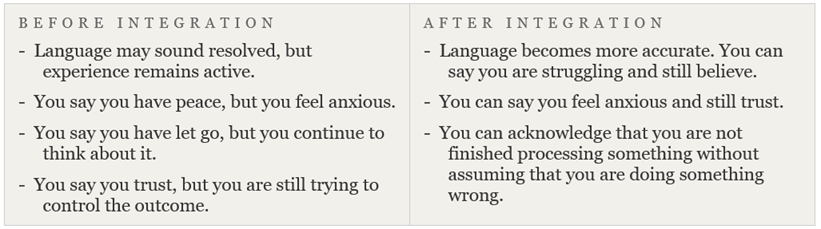
This does not make you less faithful, but it can make you more aware.
The goal is not to remove spiritual language from your life. It is to ensure that it reflects your actual experience rather than replacing it. When your words align with what is happening internally, your growth becomes more consistent. You are working with your experience instead of working around it. This is where meaningful change occurs.
Faith was never intended to eliminate your emotional process. It was meant to exist within it. When you allow both to operate together, you create a more complete and grounded way of engaging with yourself, your relationships, and your beliefs.
You do not have to choose between being faithful and being honest about what is happening inside of you. Those two things were always meant to work together.