
Journaling Has More Than One Job: Why It Works, When It Does Not, and How to Use It
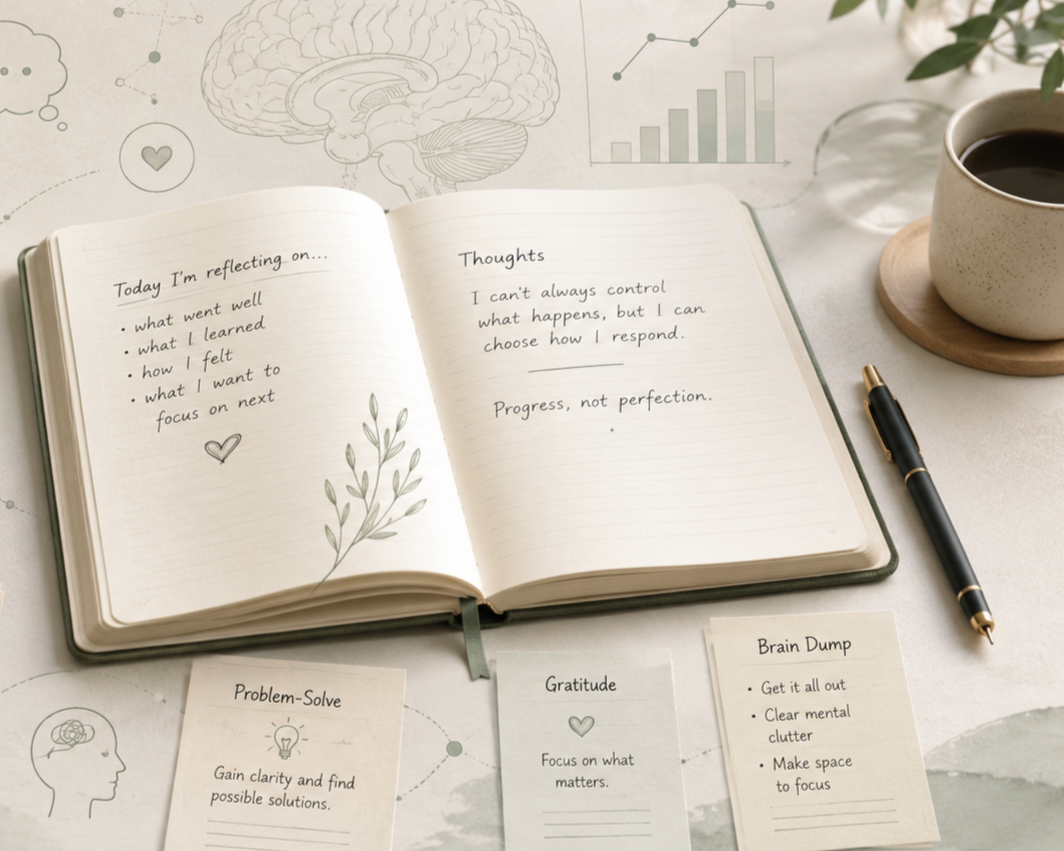
Journaling has a branding problem.
Mention it, and many people immediately picture a beautifully organized notebook filled with long, emotional entries beginning with “Dear Diary.” Others imagine gratitude lists, decorative stickers, or someone documenting every detail of the day.
Those are valid forms of journaling, but they represent only a small part of what writing can do for the mind.
A journal can help you process emotion, examine an automatic thought, track a behavior, prepare for a difficult conversation, organize a decision, identify a pattern, or clear enough mental noise to focus. It can contain complete paragraphs, unfinished sentences, charts, drawings, questions, lists, or three irritated words written before bed.
You do not have to enjoy writing. You do not need to do it every day, and your entries do not have to be deep, positive, poetic, or preserved for future generations.
Journaling is not a personality type; it is a tool that can be picked up and put down as needed.
The more useful question is not, “Am I someone who journals?” It is:
What do I need this page to help me do?
Why Moving a Thought Onto Paper Matters
Thoughts inside the mind can feel urgent without being clear. They move quickly, trigger emotion, circle back, and combine facts with fears, assumptions, memories, and imagined outcomes.
Writing slows that process down, and once a thought is recorded, it becomes something you can observe rather than something you are only experiencing. You can examine its accuracy, notice what is missing, compare it with other information, and decide whether it requires action.
This does not mean writing automatically makes a thought more rational, since a person can write the same fear fifty times and remain just as stuck. The potential benefit comes from what writing allows the mind to do next.
Writing May Reduce Mental Crowding
Working memory is the limited mental space we use to hold and work with information. Worry, intrusive thoughts, unfinished tasks, and efforts to avoid thinking about a stressful experience can occupy some of that space.

In a study by Klein and Boals, participants who completed structured expressive writing exercises showed improvements in working memory capacity and reductions in intrusive thinking. The authors proposed that organizing a stressful experience through writing may reduce some of the mental effort involved in repeatedly suppressing or mentally rehearsing it.
This does not mean every brain dump improves memory, though it suggests that certain forms of structured writing may help the mind stop carrying the same information in several directions at once.
Naming an Emotion Can Change How We Relate to It
An emotion can feel especially overwhelming when it remains a physical and internal experience: tightness in the chest, racing thoughts, agitation, dread, or the urge to escape.
Putting a name to that experience creates a small amount of distance from it. Instead of only feeling anxious, a person may begin to observe, “I am anxious because I believe I am about to fail.”
Research on affect labeling, which is the process of putting feelings into words, has found that naming emotional content can reduce reactivity to negative stimuli. One neuroimaging study found reduced amygdala activity and increased activity in a prefrontal region while participants labeled emotional images.
That study did not test journaling specifically, so it should not be treated as proof that writing in a notebook directly changes the brain, though it does support the broader idea that converting emotion into language may assist regulation.
Naming a feeling does not eliminate it, but it gives the mind more information about what is happening.
Writing Can Organize an Experience
Stressful situations are not always remembered as neat stories. A person may recall one image, a physical reaction, something another person said, and a harsh conclusion about themselves.
Writing can help connect those fragments by asking what happened, what you felt, what you assumed it meant, what you did afterward, and what you believe about it now.
This process can reveal that the most painful part of an experience is not always the event itself. Sometimes it is the conclusion that follows, thoughts such as “I should have known,” “I cannot trust anyone,” “I always ruin things,” or “I have no control.”
A journal provides a place to identify those conclusions and evaluate whether they remain accurate or useful.
There Is No Universal “Journaling Effect”
One reason journaling is misunderstood is that very different writing practices are placed under the same label.
Expressive writing, gratitude exercises, CBT thought records, symptom tracking, and goal monitoring all involve recording information, but they do not serve the same purpose or operate through identical psychological processes.
A 2022 systematic review and meta-analysis found an overall benefit for journaling interventions used alongside mental-health treatment. However, the researchers also noted substantial differences in what participants wrote, how much instruction they received, how often they completed the exercises, and which outcomes were measured.
Research does not show that all writing is automatically therapeutic. It suggests that particular forms of writing may help certain people under specific conditions, and that distinction matters when choosing an approach.
Different Types of Journaling Serve Different Purposes
There are many journaling styles, but readers do not need to memorize a long list of categories. Most approaches fall into four broader functions.
1. Journaling to Process an Experience
Expressive and reflective journaling can help a person put language around something emotionally significant.
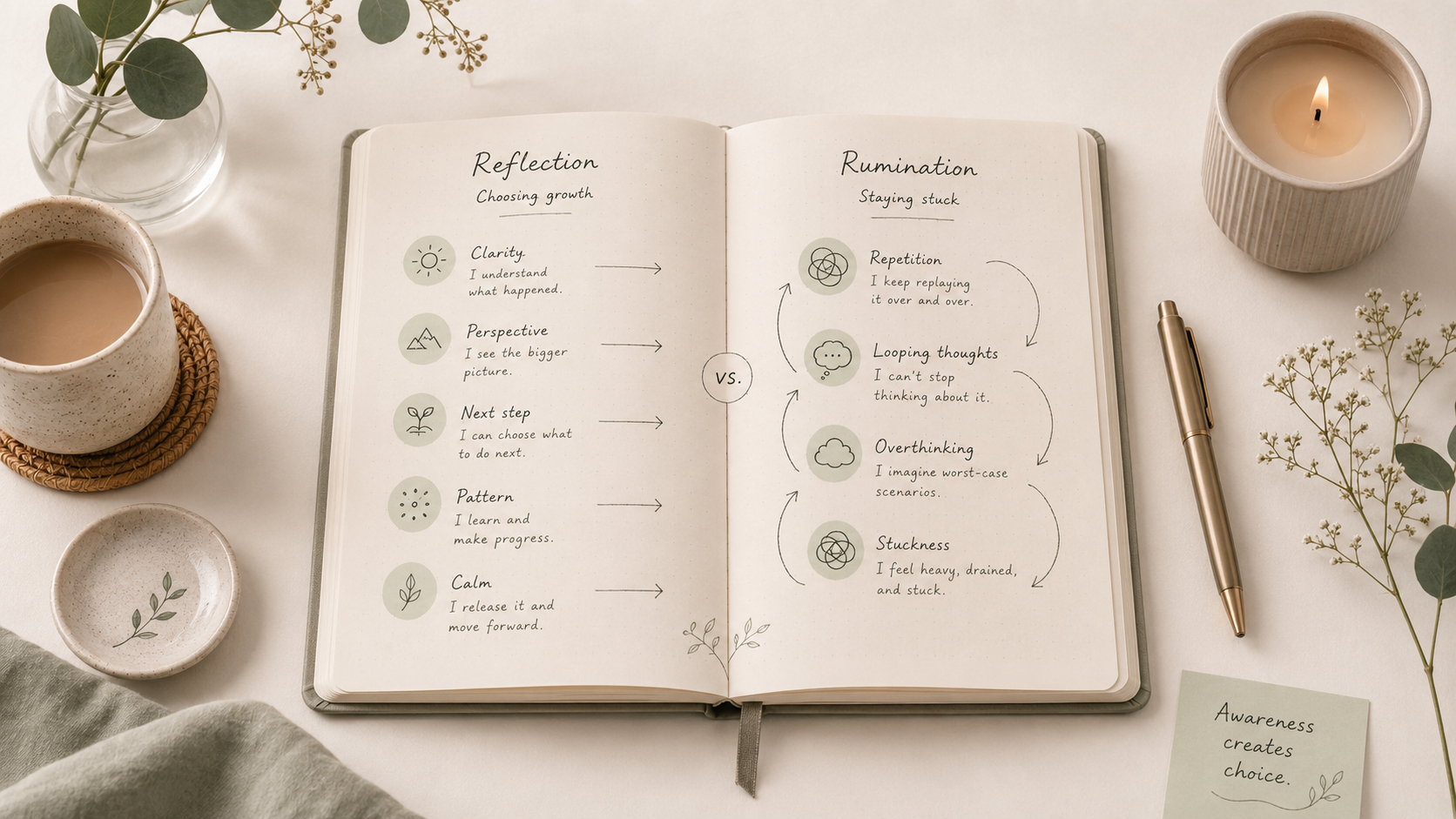
Expressive writing usually focuses on deeper thoughts and feelings related to a stressful or meaningful event. Traditional research protocols often ask participants to write continuously for approximately 15 to 20 minutes over several sessions.
Reflective writing goes a step further. Rather than only describing what happened, it asks what affected you most, what you needed in that moment, what you are still carrying from it, and whether your understanding has changed.
Creative or visual methods can serve a similar purpose through drawings, poetry, diagrams, colors, collage, or brief phrases, since not every internal experience arrives in paragraph form.
These approaches may help organize an experience, but emotional intensity is not the same as productive processing. Writing five pages of painful details is not necessarily more useful than writing one honest paragraph that identifies what still hurts and why.
2. Journaling to Understand a Pattern
A cognitive entry might look like this:
Situation: My supervisor asked to speak with me.
Automatic thought: I must have done something wrong.
Emotion: Anxiety.
Behavior: I mentally reviewed every mistake I made this week.
Facts available: My supervisor asked for a meeting but did not say I was in trouble.
Alternative explanation: My supervisor may need information or want to discuss an ordinary work matter.
Next step: Attend the meeting before deciding what it means.
Cognitive journaling, mood tracking, symptom logs, and habit monitoring help make recurring patterns easier to see.
The purpose is not to replace every uncomfortable thought with a positive one. It is to separate what actually happened from the interpretation added by the mind.
Tracking can also reveal connections that memory tends to miss. A person may discover that irritability increases after poor sleep, anxiety rises before certain interactions, or avoidance provides immediate relief but creates more stress later.
Research across 138 studies found that monitoring progress was associated with improved goal attainment, particularly when progress was physically recorded or reported. A written record can make vague intentions more observable and measurable.
3. Journaling to Solve a Problem
Problem-solving and values-based journaling can help when the mind is circling a decision without reaching one.
Someone thinking about leaving a job may repeatedly write, “I hate my job,” without becoming any clearer. A more structured entry could ask:
What specifically is not working?
Which conditions could realistically change?
What am I afraid will happen if I stay?
What am I afraid will happen if I leave?
What information do I still need?
What is the next decision I need to make?
Values-based writing adds another question: which choice is most consistent with the person you want to be?
The goal is not to predict every outcome or locate a perfect answer. It is to define the actual problem and determine the next reasonable step.
4. Journaling to Redirect Attention or Clear Mental Space
Sometimes the mind does not need deeper analysis. It needs a different focus or somewhere to place its mental clutter.

Gratitude journaling intentionally records meaningful, supportive, or appreciated experiences. It should not be used to deny pain, force positivity, or pretend that a harmful situation is acceptable.
Its purpose is to broaden attention, since the mind can become highly efficient at noticing threat, disappointment, and unfinished problems while overlooking neutral or supportive experiences.
A 2023 systematic review of 64 randomized trials found that gratitude interventions were associated with improvements in several measures of mental health and well-being, although the strength of the findings varied across outcomes.
Progress journaling serves a related function. It records what changed, what worked, what was attempted, and what a person handled differently, which can be especially helpful when the mind dismisses gradual improvement because the final goal has not yet been reached.
Before Opening a Notebook,
Consider Which Job Needs to Be Done
Processing: Organize an emotional or meaningful experience.
Finding patterns: Separate facts from interpretations and notice recurring connections.
Problem-solving: Define the actual issue and identify the next reasonable step.
Clearing space: Reduce mental clutter, broaden attention, or record progress.
Stream-of-consciousness writing, sometimes called a brain dump, is even less structured. It may contain reminders, complaints, unfinished thoughts, questions, and random concerns. Its purpose is not always to produce insight; sometimes it simply clears enough mental noise to identify what actually requires attention.
These approaches can overlap, as one entry might begin as a brain dump and eventually reveal a pattern while another may start with an emotion and end with a decision.
The important distinction is whether the writing is helping the mind move toward clarity or simply giving it another place to keep circling.
Reflection and Rumination Are Not the Same
Journaling can be helpful, but it can also become another place to rehearse distress.
Productive reflection usually creates some form of movement. You may develop clearer language, recognize a pattern, identify a need, question an assumption, make a decision, or determine a next step.
Rumination tends to repeat the same accusation, fear, regret, or unanswered “why” without producing new information.
Research has found that expressive writing does not benefit everyone equally. In one study of adults experiencing a recent marital separation, expressive writing appeared to interfere with recovery for some participants, particularly those already engaged in considerable meaning-making or repetitive mental processing.
Pay attention to what happens after you write. Do you feel clearer, more organized, or better able to choose your next action, or are you more activated and repeating the same material?
When writing consistently leaves you overwhelmed, disconnected, or trapped in painful memories, more writing may not be the answer. A shorter, more structured method, or support from a mental-health professional, may be more appropriate.
Give the Page a Specific Job
You do not have to journal daily for it to count. You do not need a special notebook, a minimum number of pages, or a major realization after every entry.
Before you begin, ask:
What do I need this page to do today?
Suppose you had a tense conversation with your partner and cannot stop replaying it. Your answer might be:
I need this page to help me separate what was actually said from what I assumed it meant.

That answer tells you what kind of entry to write. You might divide the page into three sections: what was said, what you interpreted, and what you still need to ask. The purpose is not to write everything you feel but to create clarity before the next conversation.
On another day, your answer may be different:
I need this page to get tomorrow’s tasks out of my head so I can sleep.
That entry may be nothing more than a list, and it still counts as a meaningful use of the page. Once the page has a job, journaling becomes less about performing insight and more about using writing intentionally. After all the structure, prompts, and research, it is worth returning to the quieter purpose beneath them. Journaling gives the mind a place to pause, observe itself, and choose what happens next.
The value is not found in producing perfect pages, but in creating enough space to notice what your mind is doing and decide how you want to respond. The notebook does not contain the answers, but it creates a place where you may be able to recognize them.
Ready to Put Journaling Into Practice?

Understanding why journaling works is only the beginning. The real benefit comes from having prompts that help you use the page with intention.
Our journaling workbooks are designed to help you move beyond staring at a blank page. Each one offers structured prompts, guided reflection, and practical exercises to help you process experiences, recognize patterns, organize your thoughts, and build greater self-awareness.
Explore our journaling workbooks and find the one that gives your next page a clear purpose.