

When Rejection Feels Bigger Than the Moment
Published: Sep 28, 2026
Written By Dr. Hayley J. Willis, PsyD., LPC

Maybe your partner says no to sex, someone you love suddenly seems distant, or a supervisor corrects you in front of other people. It can even be something as simple as someone whose opinion matters disagreeing with a decision you made. These moments may look very different, but each can trigger feelings of rejection, embarrassment, or self-doubt.
On the surface, each of these is a single event, but emotionally, the moment may become much larger than what actually happened.
A declined invitation can begin to feel like, “I am unwanted.” A disagreement can become, “I am not respected.” Criticism can quickly sound like, “I am incompetent,” while distance may feel like evidence that a relationship is slipping away.
When that happens, the reaction is no longer only about the event in front of you. It is also about the meaning your mind attached to it.
For some men, that meaning can become closely connected to worth, competence, desirability, respect, or belonging. A moment of rejection may therefore carry far more emotional weight than another person realizes, especially when similar experiences have mattered deeply in the past.
The goal is not to dismiss the reaction as an overreaction. It is to understand why this particular moment may have become evidence for something much larger.

Why Some Rejection Lands Harder
Not every rejection carries the same emotional weight.
A person can tolerate disappointment in one area of life and feel completely destabilized by rejection in another. The difference often has less to do with the size of the event and more to do with what that particular experience touches.
Previous betrayal may make distance feel more threatening, while a history of conditional approval can make criticism feel like evidence that acceptance may be withdrawn. Someone who has tied worth closely to competence may experience correction as much more than information about a mistake.
Attachment experiences can also shape how people respond when connection feels uncertain. If closeness has historically felt inconsistent, unpredictable, or easily lost, small signs of distance may carry a much greater sense of danger.
None of this means every strong reaction originates in childhood or trauma. Sometimes a present-day relationship has genuinely created insecurity, and repeated disappointments within a current relationship can change how someone interprets new interactions.
The useful question is not, “Why am I reacting this way when this is not a big deal?” A better question is, “What does this moment seem to mean about me, the other person, or the relationship?”
The Moment and the Meaning Are Not the Same Thing
Events happen, and then we interpret them, often so quickly that the interpretation feels indistinguishable from the event itself.
A partner declining sex is an event, while “My partner does not want me anymore” is an interpretation. A supervisor pointing out a mistake may be feedback about one behavior, while “I am failing” becomes the broader conclusion.
Those interpretations can happen so quickly that they begin to feel like facts.
The emotional response that follows often makes sense based on the meaning that was assigned. If criticism means “I am incompetent,” shame or defensiveness may follow. If distance means “I am being abandoned,” fear, anger, or reassurance-seeking may emerge. If sexual rejection becomes “I am undesirable,” hurt may quickly turn into withdrawal or resentment.
This does not mean the original event is meaningless. Rejection can be real, criticism can be harsh, and relationships can genuinely become more distant. The important distinction is that what happened and what you decided it means are related, but they are not always the same thing.

Sexual Rejection Can Become a Verdict About Worth
Sexual rejection deserves particular attention because it can quickly become tied to desirability, masculinity, intimacy, and self-worth.
A partner saying no to sex may simply mean they are tired, physically uncomfortable, emotionally preoccupied, or not in the mood. The refusal may have very little to do with attraction.
Yet the person hearing “no” may experience something very different, such as “You do not want me,” “I am not attractive enough,” or “Something is wrong between us.”
Once that meaning takes hold, the emotional response may become much larger than the original interaction.
This does not mean sexual rejection should never hurt. Wanting intimacy and hearing no can be disappointing, especially when physical connection carries emotional significance. At the same time, a partner’s decision not to have sex should be respected without pressure, punishment, withdrawal of affection, or an expectation that they justify the decision. Both experiences can be valid at once: one person is allowed to have a boundary, and the other person is allowed to feel disappointed by it.
The important issue is what happens next.
If disappointment becomes a verdict about worth, the reaction can shift from hurt into resentment, withdrawal, anger, pressure, or emotional distance. The original rejection can then become part of a larger cycle that creates even more disconnection.
Criticism Can Feel Like More Than Feedback
Criticism can create a similar pattern, especially when competence or usefulness has become closely tied to identity.

A partner saying, “I wish you had handled that differently,” may be trying to address one specific behavior, while someone hearing the comment through a lens of inadequacy may instead receive, “You cannot do anything right.” When correction and identity become fused, defensiveness becomes easier to understand because defending the decision may feel like defending the self.
That does not mean criticism should simply be accepted without question. Some criticism is unfair, contemptuous, or unnecessarily harsh. The point is to recognize when a specific disagreement has become a broader judgment about personal worth.
These protective responses may be attempts to reduce further pain, but they can sometimes contribute to the very distance the person feared.
Event, Meaning, Emotion, Protection
One useful way to understand these reactions is through a simple sequence:
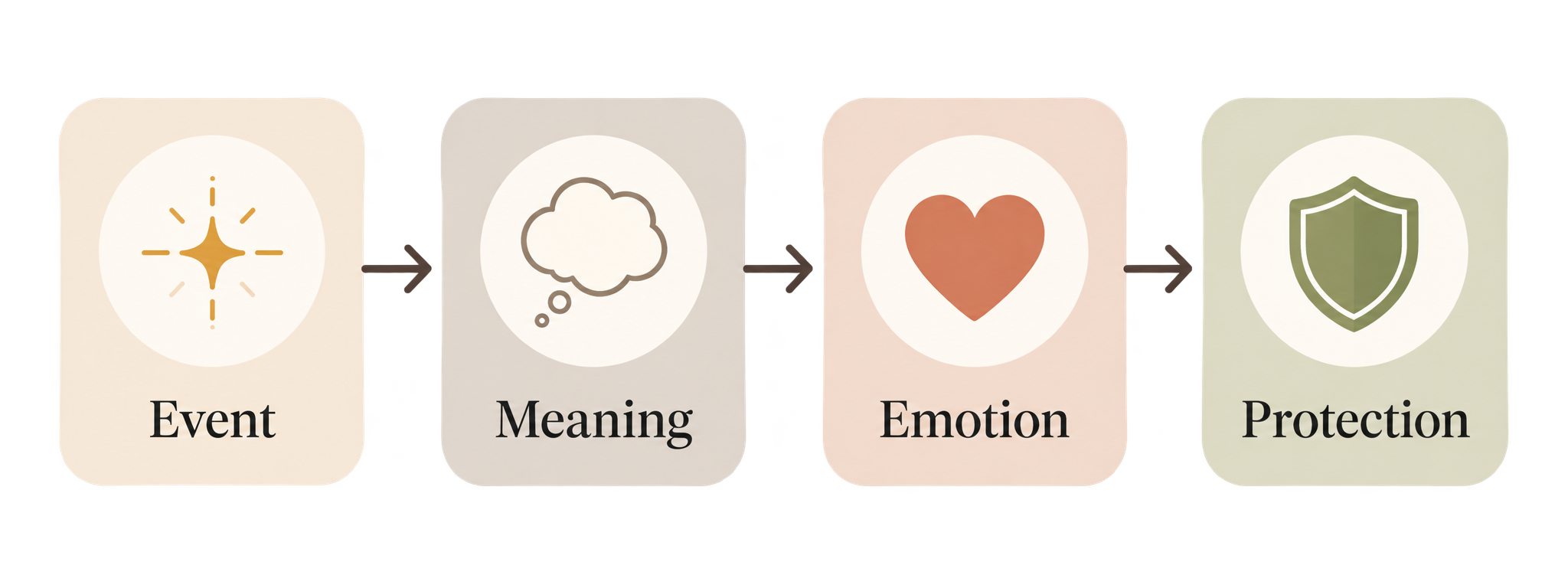
Imagine that a partner declines intimacy. The event is a declined invitation, but the meaning may quickly become, “My partner does not want me.” That interpretation may create hurt, shame, fear, or anger, which may then contribute to protective responses such as withdrawal, irritability, defensiveness, emotional distance, or pressure for reassurance.
Now consider a partner questioning a decision. The event is disagreement, but the meaning may become, “My partner does not respect me.” That interpretation may create embarrassment, anger, rejection, or insecurity, followed by arguing, shutting down, trying to prove the point, or refusing to engage.
The protective behavior becomes easier to understand once the meaning is visible. This sequence does not assume that every interpretation is wrong; it simply helps identify where the reaction may have become larger than the event itself.

Protective Reactions Can Create What You Fear
This is where sensitivity to rejection can become especially painful.
A person feels unwanted and withdraws to protect himself, while his partner experiences the withdrawal as distance and pulls back further. Someone who fears being disrespected may respond with anger or defensiveness, making the other person less willing to communicate openly.
These protective responses may be attempts to reduce further pain, but they can sometimes contribute to the very distance the person feared.
Recognizing this does not mean blaming someone for having a sensitive reaction. It means becoming curious about whether the strategy used to protect yourself is actually moving you toward what you need.
Separate the Event From the Verdict
When a moment feels much larger than expected, it can help to slow the sequence down and ask:
What actually happened?
What did I decide it meant?
What did I feel because of that meaning?
What did I do next?
Is there another reasonable interpretation that fits the facts?
The goal is not to dismiss painful reactions or assume that rejection never matters. Sometimes another person is genuinely distant, criticism is unfair, or a relationship needs attention. The purpose is to avoid turning every painful moment into a verdict about who you are.

Worth Does Not Have to Be Re-Earned in Every Interaction
This is where Under the Armor comes full circle.
Across Under the Armor, we have explored how usefulness can become connected to worth, how limited emotional language can complicate distress, how anger may become particularly accessible, and how problem-solving can become a familiar way of showing care. When connection itself feels threatened, those patterns can converge in a single interaction.
The work is not about becoming less masculine, less independent, less practical, or less capable. It is about developing enough flexibility that your identity does not depend on being useful in every moment, being right in every disagreement, remaining emotionally unaffected, or being wanted every time you reach for connection.
As a final reflection, consider this:
“If your worth does not have to be earned through usefulness, competence, emotional control, being right, or being wanted in every moment, what becomes possible in your relationships?”
That question reaches back to where this series began because sometimes the strongest thing a person can do is not prove that he is needed, respected, right, or wanted.