
Boundaries vs. Expectations: Why Your Boundaries Aren't Working in Relationships
I spent years telling people my “boundaries” only to feel consistently ignored. It took a long time to realize I was not setting boundaries at all; instead, I was issuing demands and calling them self-care.
That realization was not immediate or comfortable. It required me to step back and examine something I thought I understood. I had been communicating clearly, expressing my needs, and advocating for myself. Yet I still felt frustrated, dismissed, and at times even resentful. The problem wasn’t that I was speaking up. The problem was that I misunderstood what I was actually asking for.
The difference between boundaries and expectations is subtle at first, but it reshapes how relationships function once you see it clearly.
The Subtle Confusion Between the Two
Boundaries and expectations often get grouped together because both involve needs, values, and how we relate to others. However, they operate in entirely different ways.

Expectations are focused on what you want someone else to do. They rely on another person’s behavior in order to be fulfilled.
Boundaries are focused on what you will do. They remain within your control regardless of what the other person chooses.
That distinction is easy to overlook, especially if you were never taught how to differentiate between expressing a need and attempting to manage someone else’s behavior. Many people move through relationships believing that clarity, effort, and emotional investment will eventually lead to reciprocity.
It does…sometimes….but often, it does not.
Expectations: Where Frustration Quietly Builds
Expectations are not inherently problematic. They reflect important desires for respect, consistency, and care. The issue begins when expectations become the primary way we try to create stability.

When your sense of security depends on someone else meeting your expectations, your emotional state becomes tied to variables you cannot control. Even reasonable expectations can lead to repeated frustration when the other person does not share the same awareness, priorities, or capacity.
This is where something deeper often emerges. For many individuals, especially those with attachment injuries, expectations are not only about present-day needs, but can also reflect an attempt at repair.
Repair, in this context, means hoping that someone else will respond in a way that heals an older wound. It might be a desire to finally feel prioritized, understood, or chosen. The difficulty is that this places a significant burden on the relationship. You are asking someone to resolve something they did not create and may not even fully understand.
That dynamic rarely leads to resolution. It often leads to exhaustion.
The Safety Trap of Expectations
Expectations can feel productive. You are communicating, explaining, and trying to improve the relationship, which creates the sense that something is being addressed.
This is where expectations often function as a form of what I describe as a safety trap. They give the appearance of action without actually shifting the underlying dynamic. You continue to express what you need, the other person continues to fall short, and the cycle repeats.
Over time, this pattern can become draining. You may start questioning whether you are asking for too much or whether you are failing to communicate effectively. In many cases, neither is true.
You are attempting to create change in a space where you do not have control.
Boundaries: Where Stability Begins
Boundaries shift the focus inward. They are not about controlling someone else’s behavior. They are about defining your own.
A boundary clarifies what you will do when a situation no longer aligns with your values. It might involve stepping back, disengaging, or limiting access. The key is that it does not require the other person to change in order to be effective. This is where boundaries often feel more difficult to implement, because they require acceptance. You have to acknowledge the reality of the situation rather than keep negotiating based on what you hope it could become.
They also require follow-through. Without action, a boundary becomes another statement that does not hold weight, but what makes a boundary effective is not how clearly it is communicated, but how consistently you uphold it.
What This Looks Like in Practice
This distinction becomes much clearer when you see it applied in real situations.
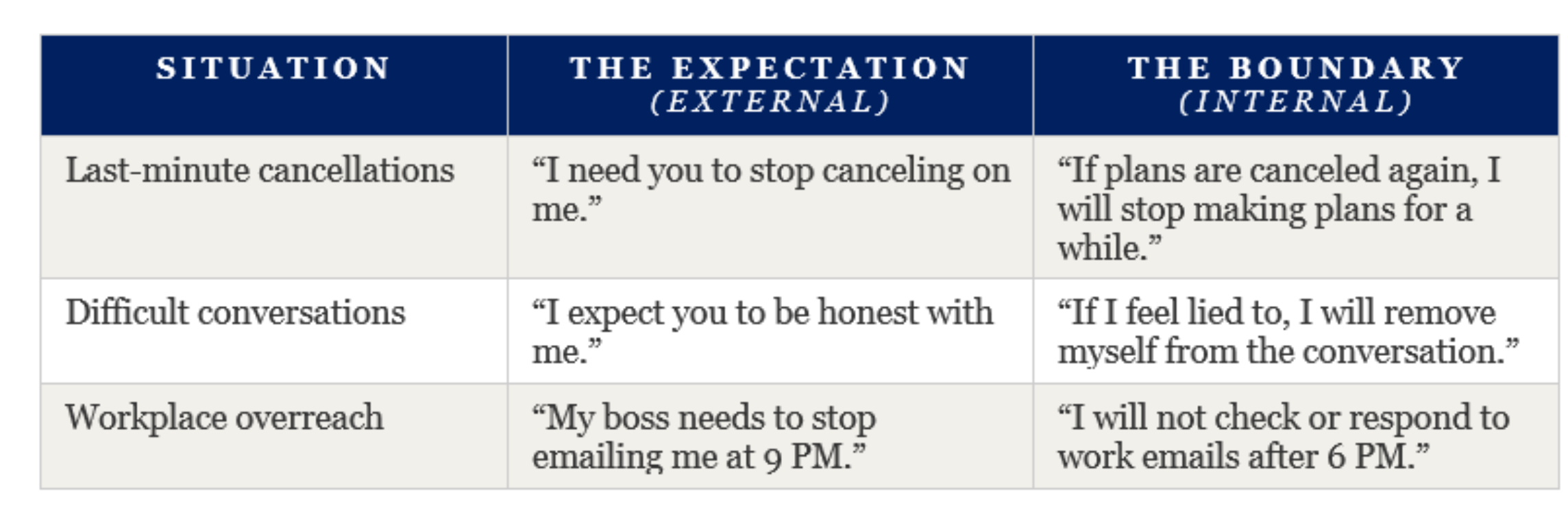
The difference is not in the seriousness of the issue. It is where the responsibility sits.
Expectations place responsibility on the other person. Boundaries place responsibility on you.
Why This Shift Feels So Uncomfortable
Expectations help you stay engaged in the relationship while holding onto the hope that things will improve. They keep the connection intact, even when it is inconsistent.
Boundaries introduce the possibility that the relationship may not continue in the same way. That can bring up grief, uncertainty, and even guilt. It requires you to consider what happens if the other person does not meet you where you are.
For individuals with trauma histories, this can feel particularly intense. Expectations can become tied to the desire for repair, while boundaries can feel like withdrawal. In reality, boundaries are not about disconnecting from others, but about staying connected to yourself.
Illusion of Control
One of the more difficult realizations is that expectations often create an illusion of control. They suggest that if you explain yourself clearly enough, the outcome will change.
That is only true when the other person is both willing and able to respond differently. When those conditions are not present, expectations do not resolve the issue. They extend it.

Boundaries remove that illusion. They do not attempt to influence another person’s behavior. They clarify how you will respond to what is already happening.
This shift can feel stark, but it is also where a more stable form of autonomy begins.
The Role of Acceptance
Boundaries require you to see the relationship as it is rather than as you wish it could be. This is not about becoming detached or indifferent. It is about recognizing patterns and responding to them honestly.
It is okay if the boundary feels like a loss at first. We are often grieving the person we hoped they would be, while finally meeting the person they actually are.
Acceptance does not mean agreement. It means acknowledging reality without trying to reshape it through repeated effort. When someone consistently shows you how they engage, boundaries allow you to respond to that pattern instead of continually hoping it will change.
When Expectations and Boundaries Work Together
Expectations still have a place. They help clarify what you value and what you are looking for in a relationship. They can guide communication and set a foundation for understanding. The difference lies in what follows. Expectations can open the conversation, but boundaries determine how you respond if those expectations are not met.
Without boundaries, expectations remain requests without consequence. Without expectations, boundaries may lack clarity. Together, they create a more balanced and grounded way of relating.
Moving Toward a More Grounded Way of Relating
Shifting from expectations to boundaries does not mean becoming rigid or disconnected. It means becoming more aligned with yourself. You begin to notice a change in how relationships feel. There is less urgency to convince or persuade. There is less internal conflict about whether you are asking for too much. There is a clearer understanding of what you will and will not participate in.
That clarity does not eliminate discomfort. It changes how you move through it.
Where This Leaves You
At some point, the shift becomes noticeable. You feel less reactive and more steady. The cycles of frustration begin to fade because your responses are no longer dependent on someone else changing. The relationships that remain tend to feel more reciprocal, not because you forced them to be, but because they align with what you are willing to accept.
Understanding the difference between boundaries and expectations does not change other people. It changes how you relate to them, and in that shift, there is a level of stability that expectations alone can never provide.