
Avoidance Feels Like Relief Until Your Life Gets Smaller
Avoidance gets a bad reputation in mental health conversations, usually because we talk about it after it has already become a problem. What gets missed is the reason people keep doing it in the first place: avoidance works.
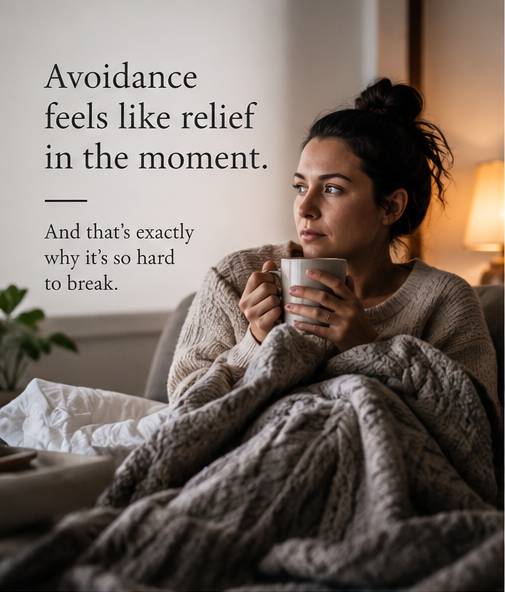
At least for a while.
You cancel the plans you have been anxious about and immediately feel your body settle down. You decide not to bring up the issue with your spouse and avoid an uncomfortable conversation. You put off making the phone call, opening the email, scheduling the appointment, driving somewhere unfamiliar, applying for the job, or going somewhere crowded, and suddenly the thing you were dreading is no longer happening today.
Your brain pays attention to that relief and eventually, it can begin learning a very convincing lesson: I felt better because I got away from it.
That lesson is where avoidance starts becoming expensive.
Relief Can Be a Powerful Teacher
When something makes us uncomfortable, our natural instinct is often to reduce the discomfort. There is nothing particularly unusual about that. If you touch a hot stove, pulling your hand away is exactly what you should do.
Anxiety becomes more complicated because the nervous system can respond to anticipated danger almost as strongly as it responds to an immediate threat. A conversation can feel dangerous because you might be rejected. Driving can feel dangerous because you once had a panic attack in the car. A crowded store can feel risky because you worry you will become overwhelmed and will not be able to leave quickly enough.
When you avoid the situation and anxiety decreases, the brain receives reinforcement for escaping.
The problem is that you never get the opportunity to learn what would have happened if you stayed.
You may have been uncomfortable and still handled it. The anxiety may have peaked and eventually decreased. The conversation may have been difficult without becoming catastrophic. You may have discovered that you were far more capable than anxiety predicted.
Your Life Usually Gets Smaller Gradually
Most people do not wake up one morning and decide to organize their lives around anxiety. The restrictions accumulate quietly.
You stop going to one store because it is too crowded. Then you start shopping only at certain times. Eventually, you order everything online.
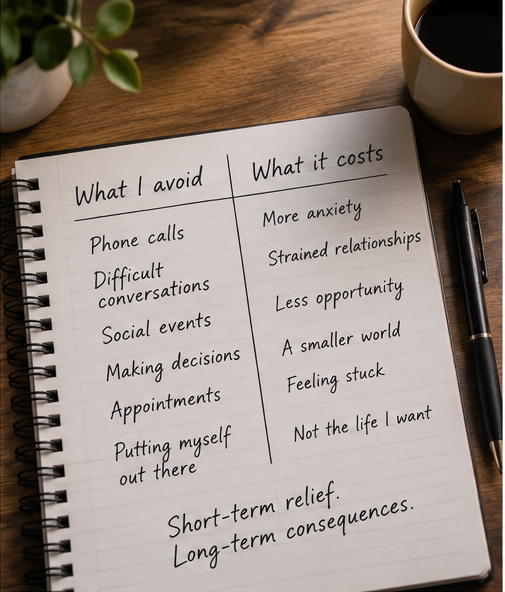
You decline one social invitation because you are exhausted, then another because you feel awkward, then several more because you have gotten used to staying home. Months later, you realize you rarely see anyone outside of work.
You avoid one difficult conversation because the timing seems bad. Then you avoid another because you already know how the other person will respond. Eventually, an entire portion of the relationship becomes something nobody is allowed to discuss.
Each individual decision can sound reasonable when viewed alone. The larger pattern becomes visible only when you look at what has disappeared from your life.
That is one of the questions I think matters most when evaluating avoidance: What am I no longer doing because I do not want to feel uncomfortable? The answer may be more informative than asking whether you feel anxious.
We Can Make Avoidance Sound Very Responsible
Adults are especially good at giving avoidance respectable names.
We call it protecting our peace, waiting for the right time, knowing our limits, staying in our comfort zone, avoiding drama, being realistic, or deciding something simply is not worth the stress.
Sometimes those descriptions are completely accurate. You should have boundaries. You do not need to expose yourself to every unpleasant person or tolerate harmful situations simply to prove you can handle them.
The distinction usually becomes clearer when you look at what the decision is accomplishing.
A boundary protects something important while allowing you to keep participating in your life. Avoidance primarily protects you from an internal experience you do not want to have. If you leave a genuinely unsafe relationship, you are protecting yourself. If you stop communicating your needs in every relationship because conflict makes you anxious, something different is happening.
If you decline one event because you need rest, you are responding to your capacity. If you repeatedly decline opportunities because you might feel awkward, judged, or out of place, anxiety may be making more decisions than you realize. There is also a difference between deciding something does not matter to you and deciding you cannot tolerate how pursuing it might feel.
Those can look remarkably similar from the outside.
The Comfort Zone Can Become a Very Efficient Trap
Comfort is not inherently unhealthy. Most of us work hard specifically because we want some degree of stability, predictability, and ease in our lives.
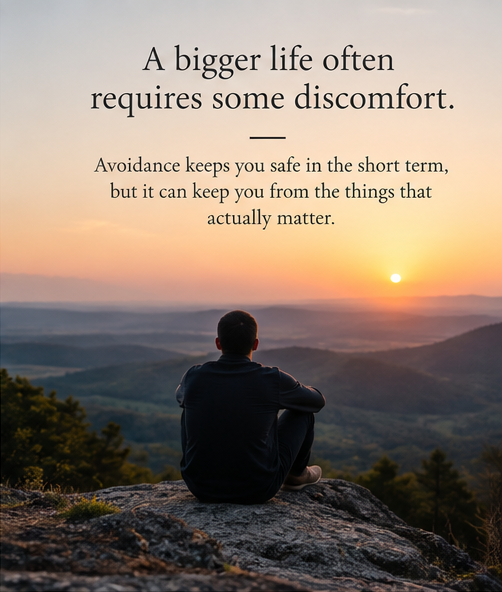
Problems begin when staying comfortable becomes more important than staying engaged.
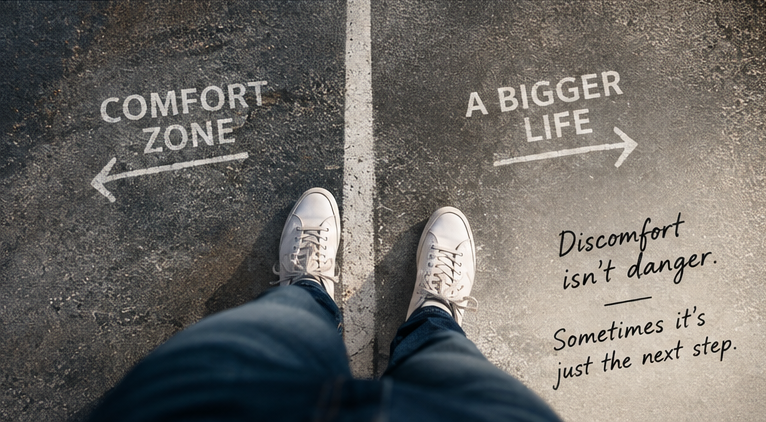
If every difficult emotion becomes a signal to retreat, discomfort gradually starts functioning like a stop sign. Anxiety says not to go, embarrassment says not to try again, uncertainty says to wait, and fear of conflict says to keep your mouth shut.
Over time, you become very practiced at arranging your environment so you rarely encounter the experiences that make you uncomfortable.
Unfortunately, confidence does not usually develop under those conditions. Confidence is often built after doing something while uncertain, anxious, embarrassed, disappointed, or afraid and discovering that you remained capable through the experience.
This is also one reason people can understand their anxiety extremely well and still remain stuck. Insight helps you understand the pattern, but understanding why you avoid something does not automatically teach your nervous system that you can tolerate it.
At some point, behavior has to become part of the work.
Waiting Until You Are Not Anxious Can Keep You Waiting
One of the more frustrating expectations people bring into anxiety treatment is the belief that they should feel ready before they do the difficult thing. They want enough coping skills to guarantee they will not panic, enough confidence to know the conversation will go well, or enough certainty that the decision will be correct.
Unfortunately, anxiety is rarely generous enough to provide those guarantees. You may have to make the call while your heart is beating faster than you would like. You may have to attend the event, knowing you could feel uncomfortable. You may need to tell someone what you actually think without knowing exactly how they will respond.
The goal is not to make yourself miserable for the sake of proving a point. Effective behavioral change is usually much more deliberate than that. You choose challenges that are meaningful and manageable enough to practice, allow discomfort to occur without immediately escaping it, and give your brain enough repetition to learn something different.
In therapy, this may involve gradual exposure, behavioral experiments, acceptance-based strategies, or identifying the values that make discomfort worth tolerating in the first place. ACT can be particularly useful here because it does not require you to eliminate anxiety before participating in your life. The question becomes whether anxiety gets to determine what you do next.
Safety Behaviors Can Hide Inside Participation
Avoidance is not always obvious because sometimes you technically do the thing while still protecting yourself from fully experiencing it.
You go to the restaurant but sit near the exit. You attend the event but remain on your phone so you do not have to interact. You drive somewhere but only if another person comes with you. You speak during the meeting but rehearse the sentence repeatedly beforehand and spend the next hour analyzing whether you sounded stupid.
These strategies are often called safety behaviors because they help someone feel more protected while entering an anxiety-provoking situation.
Some support is reasonable, especially when you are beginning to challenge a longstanding fear. The concern is whether the support becomes evidence in your mind that you survived only because the safety behavior was present.
Then the brain learns, “I can handle the grocery store as long as someone comes with me,” rather than, “I can handle the grocery store.” That distinction matters when the larger goal is independence.
Sometimes Avoidance Looks Like Productivity
Not everyone avoids by hiding under the covers.
Some people stay remarkably busy.
They clean instead of completing the difficult assignment. They work late instead of going home to a strained relationship. They help everyone else solve their problems because dealing with someone else's problem is easier than confronting their own. They research every possible option for months because making an actual decision creates uncertainty.
Productivity can become a very effective form of avoidance because it comes with praise.
Nobody worries about the person who is getting a lot accomplished.
Still, being busy and moving forward are not always the same thing.
Sometimes you have to ask whether everything you are doing is helping you approach the life you want, or simply giving you legitimate reasons not to address the thing you already know needs your attention.
Getting Your Life Back Usually Requires Some Discomfort
I do not think the goal of anxiety treatment should be to become fearless. Fear is useful. Anxiety is part of being human, and discomfort will continue showing up regardless of how much therapy you complete.
The more useful goal is having enough flexibility that discomfort does not automatically dictate your behavior.
You can feel anxious and go somewhere anyway. You can dislike conflict and still speak clearly. You can be uncertain about how someone will respond and still say what needs to be said. You can have an uncomfortable physical sensation without immediately organizing your day around making sure it never happens again.

The change may initially look small because you are reversing a pattern that was built through repetition. Take the slightly longer route. Stay ten minutes longer. Make the call you have been postponing. Go into the store instead of ordering online. Say what you mean instead of editing it until nobody could possibly be upset.
Then pay attention to what actually happens. Your brain needs evidence, and evidence usually comes from experience. Working through that process in adult therapy gives you a structured space to build that evidence at a manageable pace.
Avoidance will almost always have a good argument for why today is not the day to challenge it. There will be another reason to wait until you feel calmer, more prepared, less tired, more confident, or completely certain.
The bigger question is what continuing to wait is costing you.
Relief feels good in the moment, and sometimes relief is exactly what you need. When the same strategy repeatedly removes relationships, experiences, responsibilities, independence, or opportunities from your life, however, it is worth asking whether you are actually protecting your peace or slowly building your world around fear.