
Good Vibes, Bad Mirror
Toxic Positivity and the Harsh Reality of Social Media

Your social media feed is probably not lying to you in the traditional sense. Most of the vacations happened. The promotions were real. The smiling couples may genuinely love each other. The fitness transformations, business launches, birthday celebrations, and carefully photographed Sunday mornings are not necessarily fabricated.
The deception is found in what remains outside the frame.
You do not see the argument that happened before the anniversary picture. You do not see the debt behind the luxury purchase, the panic beneath the career announcement, or the loneliness sitting beside the person posting about self-love. You see the breakthrough without the breakdown, the lesson without the confusion, and the confidence without the hours spent questioning whether any of it was good enough.
Social media does not merely show us other people’s lives. It presents highly selective evidence about what a life is supposed to look like.
Over time, that evidence can become a mirror. Unfortunately, it is a distorted one.
.
— WHEN POSITIVITY BECOMES A PERFORMANCE —
Positivity is not inherently harmful. Hope can help people endure painful circumstances. Gratitude can widen attention beyond immediate frustration. Encouragement can remind someone that a difficult moment is not the entirety of their existence.
Toxic positivity is different.
It is the pressure to maintain a positive emotional presentation regardless of what is actually happening. It treats sadness as a mindset problem, anger as a character flaw, grief as something to outgrow, and uncertainty as evidence that a person has not worked hard enough on themselves.
It sounds like:
“Everything happens for a reason.”
“Just focus on the good.”
“Other people have it worse.”
“Protect your energy.”
“Choose happiness.”
“At least you learned something.”
These phrases are not always cruel. Many are spoken by people who genuinely want to help. The problem is that they can shut down emotional honesty rather than support it.
There is an important difference between helping someone find hope and demanding that they stop expressing pain. One creates room for the full experience. The other replaces reality with a more socially acceptable version.
Online, this replacement can become a lifestyle.
People are encouraged to turn suffering into wisdom before they have even processed what happened. A breakup becomes a post about knowing your worth. Burnout becomes a lesson about boundaries. Grief becomes a tribute accompanied by a polished photograph. A mental health crisis becomes a recovery narrative with a clean beginning, middle, and end.
Even vulnerability is often expected to be attractive, concise, and inspiring.
You can struggle online, but preferably in a way that reassures everyone that you are already becoming stronger.
— THE FEED DOES NOT REFLECT LIFE. —
— IT TRAINS YOU TO JUDGE IT. —
The harshest feature of curated happiness is not simply that it makes other people appear happier. It can quietly change the standard by which you evaluate your own life.

A person opens an app during an ordinary evening. They may be tired, uncertain about their future, mildly irritated with their partner, worried about money, or simply bored. Within minutes, they are shown someone celebrating an engagement, another person buying a home, a former classmate earning a promotion, an influencer exercising at sunrise, and a family taking professional-quality photographs on a beach.
Nothing catastrophic has happened to the viewer. Their life may be stable, meaningful, and progressing at a reasonable pace.
Yet it suddenly feels insufficient.
This is the comparison trap: you compare your complete internal experience with someone else’s edited external presentation. You know every doubt, delay, mistake, and unflattering detail of your own existence. You know almost none of theirs.
Research does not support the simplistic claim that all platform use damages everyone in the same way. Reviews have found that the relationship between online activity and mental health is often complex, variable, and dependent on the person, content, behavior, and surrounding circumstances. However, social comparison, appearance-focused engagement, feedback seeking, and intense self-presentation have repeatedly emerged as meaningful risk pathways.
A meta-analysis examining social networking sites and depression found that upward comparison was more consistently connected with depressive symptoms than time spent online alone. In other words, the number of minutes may matter less than what your mind is doing during those minutes.
They are moving forward ……. I am falling behind.
They are confident ……. Something must be wrong with me.
They are enjoying their life ……. Why can’t I appreciate mine?
The platform provides the material. Your brain turns it into a verdict.
That final question is where curated happiness becomes particularly damaging. It does not only produce envy. It can create shame about having normal emotional reactions.
— YOU BEGIN DISTRUSTING YOUR OWN EMOTIONS —
When the feed is filled with motivational captions, healing language, gratitude lists, and people insisting that peace is always a personal choice, emotional difficulty can begin to feel like personal failure.
~ You are no longer merely sad. You are failing to maintain a positive mindset.
~ You are not simply exhausted. You must have poor boundaries.
~ You are not reasonably angry about being mistreated. You are holding on to negative energy.
~ You are not grieving at your own pace. You are refusing to let go.
This is one of the more insidious effects of toxic positivity: it teaches people to evaluate emotions according to whether they are appealing rather than whether they are informative.

Anger can indicate that a boundary has been violated. Anxiety may signal uncertainty, threat, overload, or a need for preparation. Sadness can reflect loss, disappointment, disconnection, or the recognition that something mattered. Envy may reveal an unmet desire. Guilt can point toward a need for repair.
Emotions are not always accurate interpretations of reality, but they are still data. They tell us something about what our nervous system has noticed, what we value, and how we are making sense of an experience.
Suppressing emotion is not the same as regulating it. Research on emotion regulation has generally distinguished flexible strategies, such as reappraisal, from habitual expressive suppression. Meta-analytic evidence has linked greater reliance on suppression with poorer mental health and reduced well-being, although culture and context can affect how these patterns operate.
Real regulation asks, “What am I feeling, what is influencing it, and what response would be useful?” Toxic positivity asks, “How quickly can I make this feeling disappear so I can return to being acceptable?”
— THE CURATED SELF BECOMES A SECOND STANDARD —
There is another comparison occurring online that receives less attention: the comparison between your actual self and the version of you that you post.
The online version may be more confident, productive, attractive, socially connected, emotionally insightful, or successful. That version does not have to be entirely false. It may represent genuine parts of your identity. The problem begins when those parts are treated as the whole person.
You post the clean kitchen but not the room you cannot bring yourself to organize. You share the accomplishment but omit how depleted you feel. You post a photograph with friends while privately wondering whether any of them truly know you. You write about healing while avoiding the conversation that would require genuine vulnerability.

Eventually, you may begin managing your life according to how it will appear rather than how it actually feels.
Research involving adolescents has associated a strong focus on online self-presentation with more mental health concerns and lower quality of life. Other research has found that authentic self-expression online is associated with greater subjective well-being, though the reported effects are modest and do not establish that authenticity alone causes better mental health.
That distinction matters. The answer is not to post every hardship, disclose private information, or transform the internet into a public diary. Privacy is healthy. Selectivity is inevitable. Every conversation, photograph, and story involves some form of presentation.
The concern is not that you edit what strangers can access. The concern is that you begin editing what you permit yourself to acknowledge.
— EVEN “AUTHENTICITY” HAS BECOME CURATED —
Social media has recognized that polished perfection can feel artificial. In response, a new aesthetic has emerged: strategic imperfection.

The messy room is messy in an appealing way. The crying video has flattering lighting. The confession is vulnerable but carefully scripted. The “unfiltered” photo is selected from twenty-five attempts. The creator tells you they almost did not post it, although the caption, music, timing, and thumbnail have been optimized for attention.
This does not automatically mean the emotion is fake. Human beings can be sincere and performative at the same time. However, it demonstrates how easily authenticity can become another product.
Now you are not only expected to be happy. You may also be expected to struggle correctly: visibly, eloquently, and with enough self-awareness to convert pain into content. Real hardship rarely follows that format.
Sometimes suffering is repetitive, embarrassing, contradictory, and resistant to a motivational conclusion. Sometimes you understand the lesson and still feel hurt. Sometimes you are grateful and resentful. Sometimes you know a decision was necessary and still mourn what it cost.
An emotionally honest life contains mixed states. Social media often rewards emotional simplicity.
— TOXIC POSITIVITY PROTECTS THE AUDIENCE —
— NOT THE PERSON IN PAIN —
Why do people respond to distress with forced optimism?
Often, it is because pain creates discomfort for the listener. When someone says, “I am not okay,” the other person may feel pressure to fix the situation. They search for a bright side, a lesson, or a reassuring statement. The response may sound supportive, but its actual function is to make the conversation less uncomfortable.
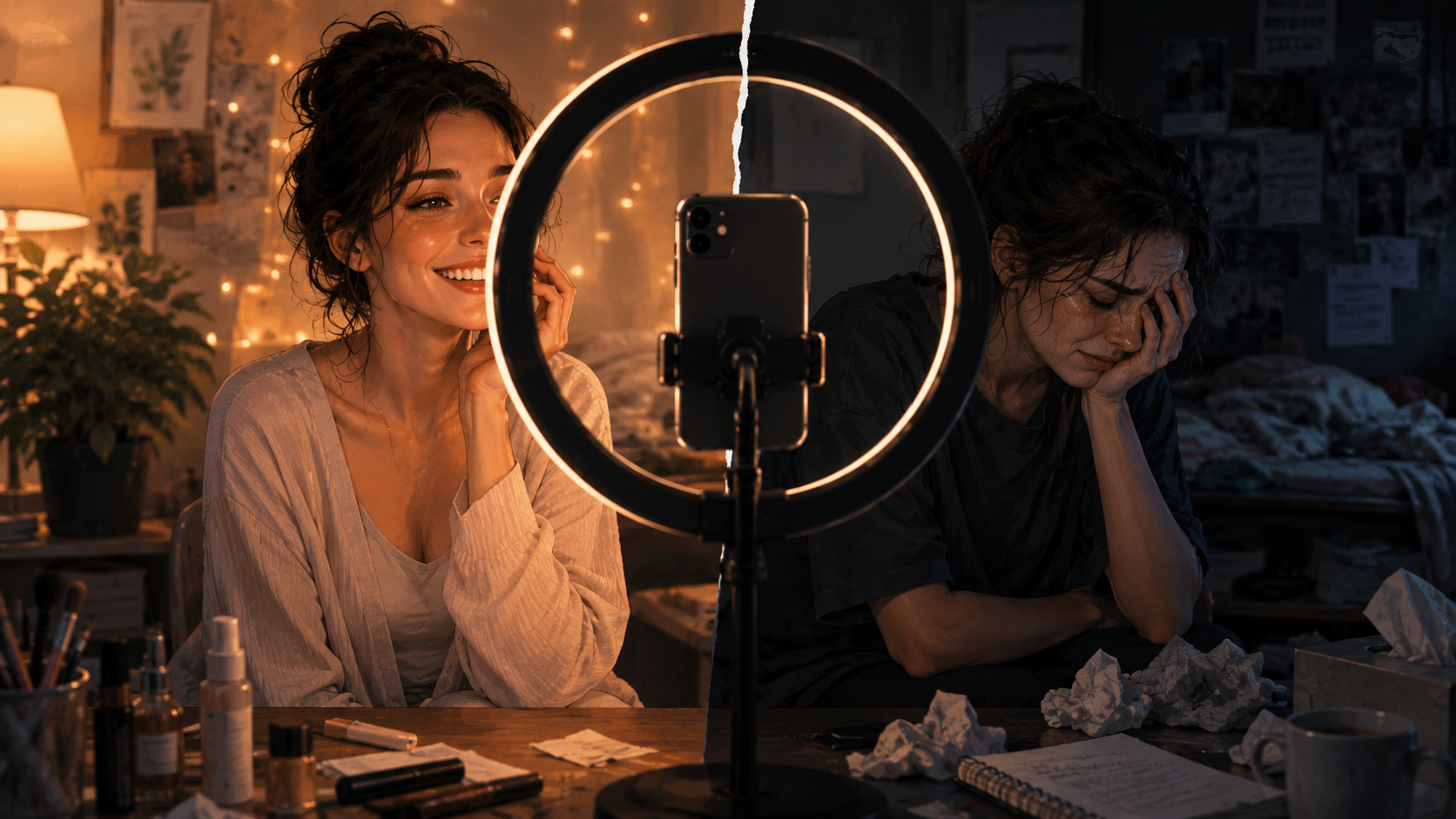
“Look at the positive” can mean, “Please stop showing me the part I do not know how to hold.”
This pattern becomes amplified online. Posts that end with hope are easier to consume. Recovery stories are more marketable than ongoing confusion. Inspiration earns approval. Unresolved suffering makes people uneasy.
Emotional invalidation involves dismissing, minimizing, or rejecting another person’s internal experience. Although research on invalidation occurs across several settings and should not be reduced to social media alone, reviews have linked persistent invalidation with shame, distress, avoidance, and worsening psychological difficulties.
Validation does not require agreement with every belief or behavior. It means recognizing that an emotional response makes sense within the person’s experience.
~ You can validate fear without encouraging avoidance.
~ You can understand anger without approving aggression.
~ You can acknowledge grief without abandoning hope.
~ You can support change without pretending the present is painless.
— POSITIVITY IS NOT THE ENEMY —
— EMOTIONAL DISHONESTY IS —
The solution is not constant negativity. Cynicism can become just as rigid as forced optimism. A person who rejects every hopeful perspective is no freer than someone who refuses to acknowledge difficulty.
Healthy positivity sounds like:
“This is painful, and you do not have to pretend otherwise.”
“I cannot promise that everything will work out, but you do not have to face it alone.”
“Your reaction makes sense. Let’s decide what would help next.”
“You can be grateful for parts of your life and still want something to change.”
“You do not need to turn this into a lesson today.”
This kind of hope does not erase reality. It stands beside it.
Psychological health requires flexibility.
— HOW TO STOP USING THE FEED AS A MIRROR —
You do not have to delete every account or abandon online connection. Social platforms can provide community, education, humor, professional opportunities, and support, particularly for people who feel isolated or have limited access to affirming spaces. The effects are not universally harmful, and research cautions against treating all users or forms of engagement as equivalent.

However, you may need to become more deliberate about what you consume and how you interpret it. Notice what happens after you scroll. Do you feel informed, entertained, connected, inadequate, agitated, or pressured to reinvent your life? The emotional aftermath may tell you more than your screen-time total.
Separate inspiration from self-punishment. Content is not motivating when it consistently leaves you feeling defective. Remember that visibility is not evidence of normality. The experiences shown most often are not necessarily the experiences people have most often.
Question any message that converts a complicated problem into a simple personal failure. Not every difficulty can be solved through discipline, gratitude, confidence, manifestation, boundaries, or a better morning routine.
Allow private experiences to remain private without treating them as shameful. You do not owe the internet proof that your life is meaningful.
Most importantly, practice emotional accuracy. Instead of forcing yourself to say, “I am fine,” try something more truthful:
“I am disappointed, but I am managing.”
“I am proud of myself and still uncertain.”
“I love this part of my life, but another part needs attention.”
“I am hopeful, but I am also scared.”
“I know I will survive this. That does not mean it does not hurt.”
— YOUR LIFE ISN’T FAILING IF IT’S NOT POSTABLE —
The harsh reality of social media is not simply that people hide their struggles. It is that constant exposure to curated lives can persuade you that struggle is an interruption rather than a normal part of being human.

Life is not a continuous display of healing, achievement, gratitude, and photogenic joy.
It includes boredom, grief, indecision, jealousy, relief, resentment, tenderness, regret, pleasure, and contradiction. It includes days that do not produce a lesson. It includes progress that nobody applauds and pain that cannot be made inspirational.
You are not emotionally unhealthy because you cannot remain positive while something hurts. You are not ungrateful because another person’s success stirred insecurity, and you are certainly not behind because your life is currently quiet, uncertain, or difficult to summarize.
The feed is a collection of selected moments. It is not a reliable standard for evaluating a human life.